
Would you like to interview one of these amazing people for Anthill?

img

Addressing the commercialisation gaps (CCI ‘Call for comment’)

smartform Addressing the commercialisation gaps (CCI Call for comment)Yesterday, I posted an article calling on members of the private sector to join me in responding to the Department of Innovation, Industry, Science and Research’s Opportunity for Comment to “help inform the development and operation of the Commonwealth Commercialisation Institute.”

I proposed to respond to each of the Opportunity for Comment’s sections, over five days, as a continuation of my initial blog post.

This is the second of five posts, devised to address the first section of the Opportunity for Comments Smart Form, which I define as:

“Addressing the Commercialisation Gaps”.

Naturally, I invite you to join me and post your own responses to each section, as a way to encourage open dialogue and the sharing of opinions. This way, when you do formerly submit your thoughts, you will do so informed by the views of many.

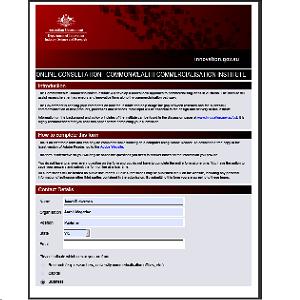
Here is what you’ll find on the Smart Form.

SECTION 1: Commercialisation in Australia

[Text below extracted from the Smart Form]

Australia has a relatively poor record of generating commercial returns from its significant investment in research and development. It is important to identify the main factors that prevent the successful commercialisation of new products, processes and services.What do you think are the main barriers to commercialising new ideas?

Comment #1 – please highlight your main message (Maximum 300 words)

What is needed to overcome these barriers?

Comment #2 – please highlight your main message (Maximum 300 words)

Now it’s your turn…

My thoughts (the first comment below) are mine only (and don’t necessarily reflect the views of Anthill). Feel free to question my assumptions, highlight concerns, provide constructive feedback or even tear my ideas to shreds.

Importantly, if you have your own responses to a section, the broader picture or the process that you’d like to share, this is your opportunity to publish your views and help guide the discussion.

Launch Post: Minister Carr wants to know how you would spend $196m
Update #3: Delivery of specialist advice (19 August 2009)


Learn from Threadless, Etsy, BoingBoing and more

Want an ad like this?

Gvivid Learn from Threadless, Etsy, BoingBoing and morelobal creative industry leaders are coming to Sydney for Vivid (25 May- 11 June).  Find out how to harness crowd funding; predict the next shift in tech adoption; explore the DNA of startups; turn failure into success. Most events free or under $30.

www.vividsydney.com

  • http://www.anthillonline.com James Tuckerman

    Comment #1: “What do you think are the main barriers to commercialising new ideas?

    The two most commonly cited barriers:

    (1) Access to talent;
    (2) Access to capital.

    Talent: “What is the definition of a commercialisation consultant? A public servant with an MBA.” There is little incentive for a seasoned business builder to engage in a government driven commercialisation institute if it is bureaucratic and cumbersome (successful business builders have a low tolerance for such things). Also, there is often too little financial incentive for anyone with a proven track record from the private sector to get involved (Pay peanuts and you get monkeys).

    Access to capital: Australia’s early-stage venture market could barely be called a ‘Venture Capital’ industry. Most VCs in Australia typically invest in mezzanine stage opportunities – not early-stage. When they do get in early, they are rarely able to provide the ‘knowledge capital’ that you might expect from a US venture fund (i.e. BDM teams and global networks). Knowledge capital in Australia is largely supplied by angels. Angel networks are the closest thing that we have to VC in Australia – yet they are under-rated, under-valued and receive very little support.

    Comment #2: “What is needed to overcome these barriers?”

    Supporting access to Talent/Capital: Unlike every other advanced industry dependent on ‘connections’ (i.e. real estate, car sales, dating) there is no formal structure for pairing ‘research/start-ups’ with capital or talent. There are hundreds of ‘capital raising cowboys’ (from advisers to consultancies) and even more ad hoc networking events (from PitchClub to PitchFest). There are no national, easily accessible channels for proven business builders to engage with ‘start-ups/research’ at ground level (other than through personal networks). This is one potential solution to facilitate access to Talent and Capital.

    [Reply]

  • Richard Wraith

    James,

    I can’t quibble at all with your observations above, they are spot on, but there is a third leg that needs to be added to make this stand up and that is “market”. Then to wrap it all together you need “culture”.

    Market:
    Start ups need to get access to and test their innovations as early as possible in their development cycle to ensure that their vision is something that enough customers will pay enough money for to build a viable business on. If not, they need to change and try again. Every successful start up will tell you that the vision they started with is not the one they eventually succeeded with. The sooner you can find a successful embodiment of your idea the better. Without a saleable product capital and talent will be wasted. But capital and talent are vital to create that saleable product.

    Culture:
    To create the right conditions for requisite talent, market and capital we need the right culture. Silicon Valley has that culture. It is a culture that exhibits many features including:
    • Enterprise,
    • Risk taking,
    • An expectation of failure as a necessary part of success (learn from experience, the inevitability of failure to find the things that will succeed etc.),
    • Rewarding success,
    • Reinvestment of that success back into new ideas
    • Celebration of disruptive change

    Finally, there is another element and that is “Critical Mass” of all of the above: Culture, Market, Capital and Talent. Without these elements in sufficient supply close enough together it is very hard for things to take off, for the necessary interactions and reactions to take place for innovation and commercialisation success.

    Is the Commercialisation Institute does anything useful it will need to deal with all these four elements and bring them together in a critical mass.

    [Reply]

  • http://www.perceptia.com Julian Jenkins

    I am not sure that my answer matches the form.

    I think the key idea behind the question is flawed. It is focused on commercializing existing research from the Academic sector.

    Unfortunately this research is generally undertaken with no commercial aims or target customer in mind. This is very valuable in creating new knowledge but rarely leads to a product that can be sold.

    We need to add an extra step to the process where we distil the knowledge gained from a research project and determine how that can best be applied to create a valuable product with a real market.

    This is much more difficult than trying to modify the output of a research project and calling it a product.

    [Reply]

  • http://www.scienceindustry.com.au Duncan Jones

    Julian has hit on a key point, how do you distil the knowledge gained from a research project and determine how and when and if it will fly in the “real” world….??
    We have been pondering this issue for some time and believe that we have hit upon a practical solution to bridge this “commercialisation gap” …A solution that we call the “Proof of Concept” checklist and associated guidelines.
    Commercial research needs to be managed differently to academic research. Commercial research typically cannot be submitted to peer review by the editorial boards of journals. This means that for commercial research universities need to establish their own internal quality control processes that mimic those established by the editorial boards of journals. In surveying Australian university commercialisation, the Science Industry found few commercialisation bodies with established processes to guide academics undertaking commercial research. CSIRO and most major overseas research universities have a ‘proof of concept’ checklist to guide researchers on commercial research.
    The ‘proof of concept’ checklist contains:

    • Clear description of the concept to be proven;

    • Statement of cost – benefit analysis for the concept which may take the form of a business case, including the novelty of the technology, intellectual property, freedom to operate in the market niche satisfied, and the market prospects;

    • A comprehensive review of the current state of the concept and the field of endeavour;

    • The likely commercial benefits of the proposal;

    • A comprehensive risk assessment; and

    • The resourcing and funding requisites.

    As well as reducing the number of poor quality commercial prospects put to industry, use of the checklist would facilitate development of some useful commercialisation metrics. For example, commercialisation bodies could publish information on the number of ‘proofs of concepts’ undertaken in their university and in what field. This would be an important indicator for industry. It could also be used by universities. For example, certified ‘proof of concept activity’ could be listed on an academic’s CV. Proof of concept activities fill a role in commercially oriented research analogous to ‘papers’ in academic research, with dollars earned, patents, etc being a measure of impact analogous to citations. The proof of concept metric is an intermediate measure of the conversion rate of ideas into marketable products, processes and services.

    [Reply]

blog comments powered by Disqus

Find Us on facebook

Latest Video

Waiting for the great leap forward? I think it’s already here [VIDEO]

Throw away your keyboard. Discard your mouse. All you need to do to control your computer is wave your hands about. No instruction manual needed, just a teeny, tiny device that reads your hand motions. Really. The revolution in human-computer interaction just took a massive leap forward.

More>>

Latest Comments

Ant Mart

Anthill Amabassadors

Anty-Climax

Sponsored by Antmart

It’s a group buying site specifically created for entrepreneurs and business builders.

More>>

thumb

Marketing & Media

Sponsored by Google

What do you know about Google AdWords? This hub was developed to answer the questions you already have, and those you haven’t thought yet to ask.

More>>

thumb

Tech & Innovation

Sponsored by AusIndustry

AusIndustry is a specialist program delivery division within the Department of Innovation, Industry, Science and Research.

More>>

thumb

Growth & Export

Sponsored by How to become a Key Person of Influence

Key People enjoy a special status in their chosen field because they are well connected, well known, well regarded and highly valued.

More>>

thumb

Upcoming Events

MAY
29

Want more leads and customers? Half day event to get big outcomes from a little budget.

Have you ever wondered… Why every industry has only a few businesses that thrive and get more leads? And they don’t suffer from cash flow problems or lack of leads, even when there is an ‘economic downturn’. They don’t have to ‘push’ or make stacks of cold calls.

More>>

MAY
22

WEBINAR: How to turn your knowledge into products… and build a global empire in your underpants!

This webinar is all about how to unlock your valuable industry knowledge and turn it into a product. It’s about how to increase the value of your business and take control of its future.

More>>