B2B Lead Generation Strategies: The Predictable System for Consistent Growth
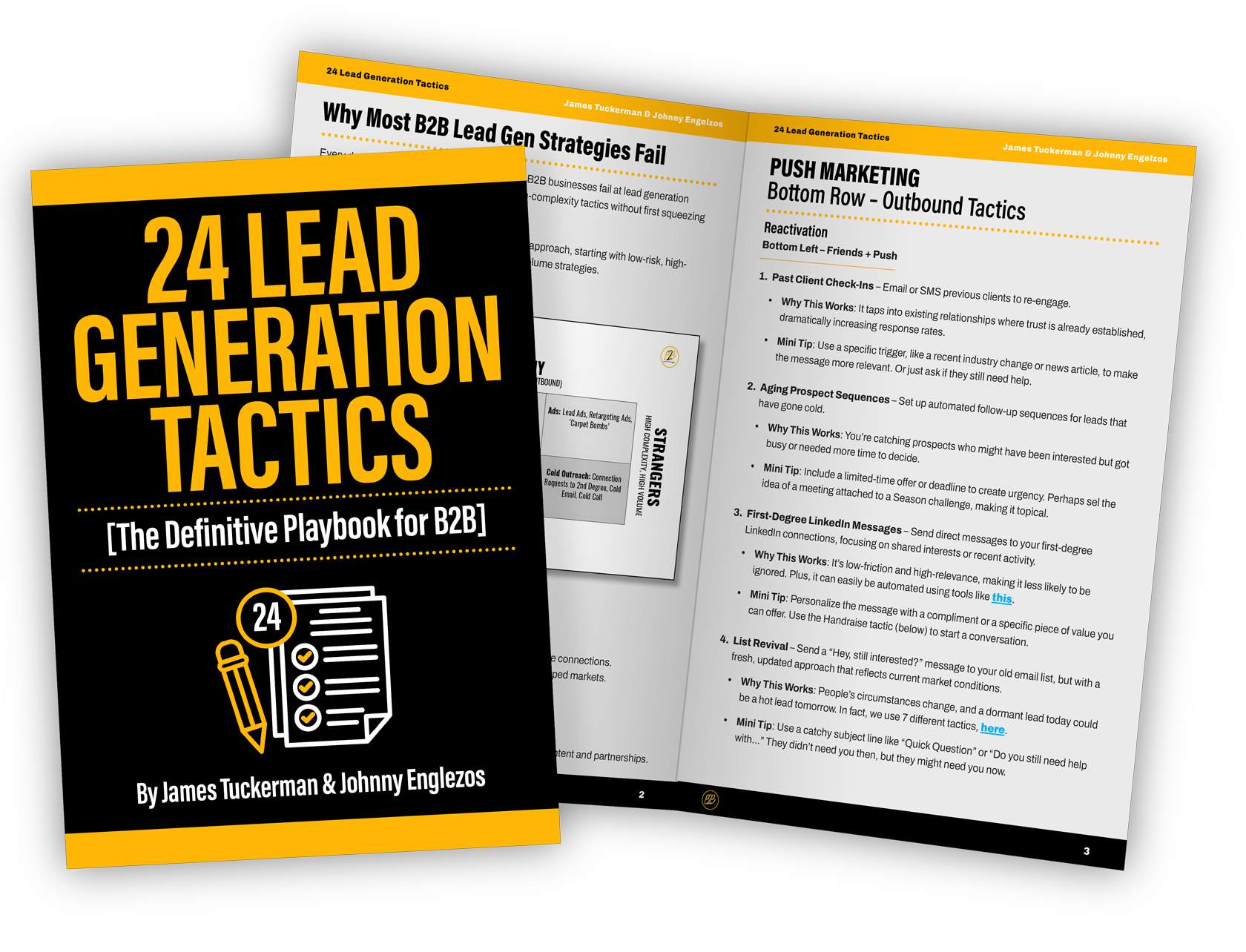
Most B2B lead generation strategies fail because businesses jump to complex, high-volume tactics before maximizing their existing network and follow-up systems. By James Tuckerman
DOWNLOAD THIS REPORT HERE [DOWNLOAD PDF].
If you’re a consultant, agency owner, or B2B service provider, you don’t have a lead problem.
You have a system problem.
Most B2B lead generation strategies fail not because they don’t work — but because they’re used out of order, without structure, and without a layered approach.
In this guide, you’ll learn how to combine B2B push vs pull marketing, build predictable lead flow, and create a system that doesn’t rely on hope, referrals, or random acts of marketing.
Let’s break it down.
Why Do Most B2B Lead Generation Strategies Fail?
Most B2B lead generation strategies fail because businesses jump straight to complex, high-volume tactics before maximizing their existing network and follow-up systems.
Instead of building from warm to cold, they go straight to strangers.
Instead of layering push and pull, they rely on one.
Instead of building a system, they collect tactics.
Here’s where it goes wrong.
The “Friends to Strangers” Mistake
The fastest leads are usually hiding in:
- Past clients
- Dormant prospects
- First-degree LinkedIn connections
- Existing email subscribers
Yet most businesses ignore these and start cold emailing strangers.
Warm contacts convert faster. Always start there.
The Push vs Pull Imbalance
Some businesses rely entirely on outbound (cold emails, DMs, calls).
Others post content endlessly and hope leads come in.
Both are incomplete.
Predictable B2B lead generation requires both push and pull working together.
No System — Just Activity
Random posting.
Random outreach.
No follow-up sequence.
No conversion gateway.
Activity is not a strategy.
A strategy connects everything.
What Is the Difference Between Push and Pull Marketing in B2B?
Push marketing is outbound outreach. Pull marketing attracts prospects to you through authority and positioning.
You need both.
Push Marketing (Outbound)
Push tactics include:
- Reactivation emails to past clients
- Referral requests
- LinkedIn messages
- Cold emails
- Outbound calls
Push creates immediate opportunity.
It generates conversations now.
Pull Marketing (Inbound)
Pull tactics include:
- Organic LinkedIn content
- Case studies
- Strategic partnerships
- Webinars
- Retargeting ads
Pull builds authority and demand over time.
It makes outbound easier because people already recognize you.
Why You Need Both for Predictable B2B Lead Generation
Push fills your pipeline this month.
Pull makes next quarter easier.
When layered correctly:
- Outbound creates immediate momentum
- Inbound compounds authority
- Retargeting bridges both
That’s how you create predictable B2B lead generation.
What Are the Most Effective Outbound B2B Lead Generation Strategies?
The most effective outbound strategies start with existing relationships before expanding to cold prospects.
Here’s the order that works.
1. Reactivation Campaigns (Low Risk, High Return)
Before going cold, reconnect with:
- Past clients
- Old prospects
- Dormant email subscribers
Simple messages work:
“Still looking to solve [problem] this quarter?”
These leads already know you. Response rates are dramatically higher.
2. Referral Multiplication Systems
Referrals shouldn’t be random.
Systemize them:
- Ask top clients for introductions
- Create a referral incentive structure
- Equip clients with short, shareable case studies
Referrals come pre-qualified and trust-loaded.
3. Cold Outreach That Actually Converts
Once warm channels are maximized, go cold — strategically.
Effective methods include:
- Targeting 2nd-degree LinkedIn connections
- Personalized cold emails referencing real pain points
- Pattern-interrupt outbound calls
Cold works when:
- It’s relevant
- It’s specific
- It’s personalized
Generic templates kill credibility.
How Do You Generate Inbound B2B Leads Consistently?
Inbound B2B leads are generated through consistent authority-building content and strategic distribution.
Not random posting.
A system.
Content Rhythms (Not Content Calendars)
You don’t need 30 posts scheduled in advance.
You need rhythm.
Post consistently:
- Case studies
- Industry insights
- Client wins
- Opinion pieces
Consistency builds familiarity. Familiarity builds trust.
Hand-Raise Posts That Pre-Qualify Leads
Ask: “Who else is struggling with [specific pain point]?”
This does two things:
- It boosts engagement.
- It identifies prospects publicly.
Now your outreach becomes warmer.
Strategic Marketing Alliances (SMAPs)
Partner with complementary businesses.
Examples:
- Email swaps
- Joint webinars
- Industry reports
- Roundtables
You tap into pre-qualified audiences instantly.
Retargeting and Lead Ads
If someone:
- Visits your profile
- Engages with content
- Clicks your links
They’re warm.
Retargeting ads keep you top-of-mind and shorten the sales cycle.
What Is a Lead Capture Gateway and Why Does It Convert Better?
A Lead Capture Gateway converts better than a traditional website because it removes distractions and leverages commitment psychology.
Most homepages convert at around 2%.
A focused landing page can convert at 10–30% when structured correctly.
Here’s why.
Zero Distractions
No menu.
No footer.
No competing offers.
One action.
Clear Value Exchange
Instead of: “Join our newsletter.”
Try: “Get the 24 B2B Lead Generation Tactics Playbook.”
Specific promise > vague invitation.
Multi-Step Commitment
Start with a simple question: “Are you looking to generate more B2B leads in the next 90 days?”
Small commitments increase follow-through.
Gamification
Three short steps before asking for contact details increases completion rates.
It feels like progress.
Do You Even Need a Website?
For lead generation?
No.
A focused landing page often outperforms a complex website because it drives one clear outcome.
Is SEO Dead — or Is AI Optimization the Future of B2B Lead Generation?
SEO isn’t dead.
But AI Optimization (AIO) is becoming critical.
Buyers now use AI tools to:
- Research service providers
- Compare authority
- Evaluate credibility
If you’re invisible to AI, you’re invisible to future buyers.
How AI Tools Decide Who to Recommend
AI systems favor businesses that are:
Clear – You solve a specific problem.
Consistent – Your message doesn’t change weekly.
Credible – You have case studies and proof.
Pattern-Rich – You show up repeatedly across platforms.
How to Become “AI Famous”
- Codify your frameworks
- Publish case studies
- Create data-rich assets
- Appear on multiple platforms
- Build digital proof
The goal isn’t just ranking in Google.
It’s being the obvious recommendation when AI is asked.
The Glue That Makes It All Work: Follow-Up
Lead generation without follow-up is wasted effort.
Every system needs three core emails:
Email 1: The Promise
Deliver the lead magnet immediately.
Build reliability.
Email 2: The Welcome
Share your story.
Humanize your brand.
Email 3: The Offer
Make a clear, direct next step:
Book a call.
Apply.
Schedule a strategy session.
Education without commercial clarity creates tire-kickers.
Frequently Asked Questions
What is the best B2B lead generation strategy?
The best strategy combines outbound push tactics with inbound authority-building to create predictable, scalable lead flow.
How long does B2B lead generation take to work?
Outbound tactics can generate leads within weeks. Inbound authority systems typically compound over 3–6 months.
Do you need a website for B2B lead generation?
No. A focused landing page or Lead Capture Gateway often converts better than a full website.
What’s the difference between inbound and outbound B2B marketing?
Inbound attracts prospects through content and positioning. Outbound reaches out directly through emails, calls, or DMs.
How do you generate predictable B2B leads?
By layering reactivation campaigns, referral systems, cold outreach, inbound authority, retargeting, and structured follow-up.
Final Thoughts: Build a System, Not a Campaign
B2B lead generation strategies don’t fail because they don’t work.
They fail because they aren’t connected.
The businesses that win:
- Start with warm contacts
- Layer push and pull
- Build authority
- Remove conversion friction
- Follow up relentlessly
That’s how you move from inconsistent leads to predictable growth.
Ready to Build Your Predictable B2B Lead Engine?
Click the image below to get the download.
James Tuckerman is one of Australia’s leading digital growth strategists and the co-founder of B2B School. He helps consultants, agency owners, and knowledge professionals package their expertise into scalable offers and build predictable lead generation systems. A serial entrepreneur and founder of Anthill Magazine, James specializes in positioning experts to become the obvious choice — both in the market and in the age of AI.

![The Gaddie Pitch in three simple sentences with Antony Gaddie and James Tuckerman [CHEAT SHEET]](https://anthillonline.com/wp-content/uploads/2015/08/GADDIE-PITCH-updated-3D-cover-.png)

![The Facebook Honey Trap with James Tuckerman [CHEAT SHEET]](https://anthillonline.com/wp-content/uploads/2015/11/Screen-Shot-2015-11-26-at-11.34.14.png)