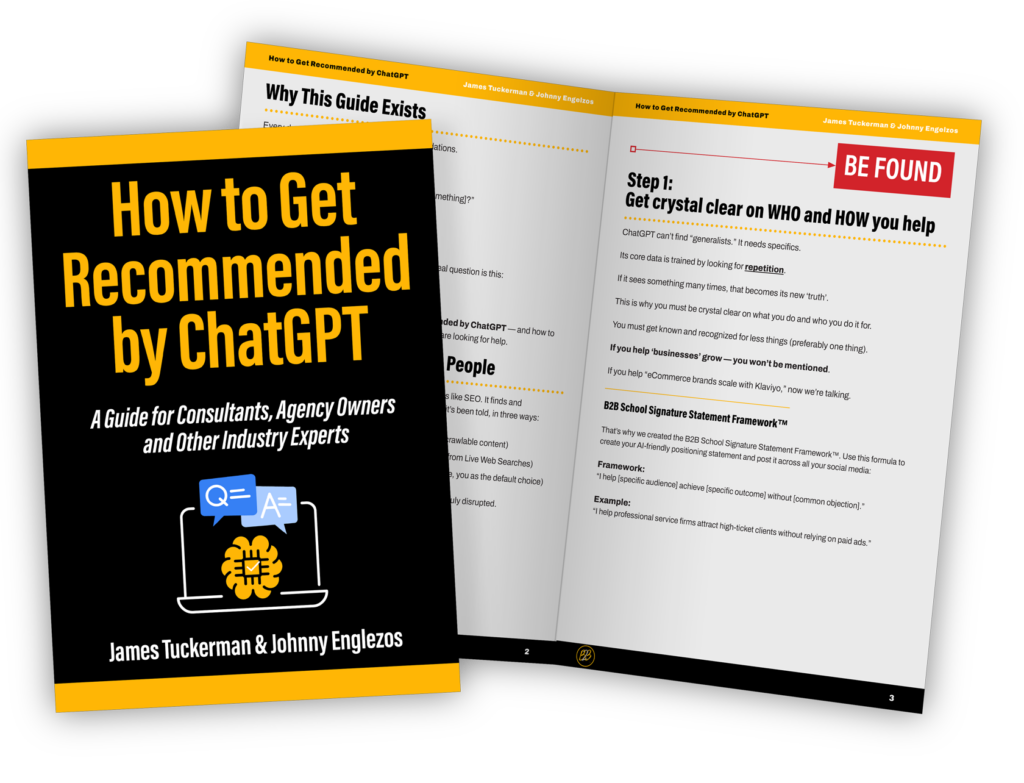
7 Online Platforms You Must Be On If You Want AI to Recommend You (Free Guide)
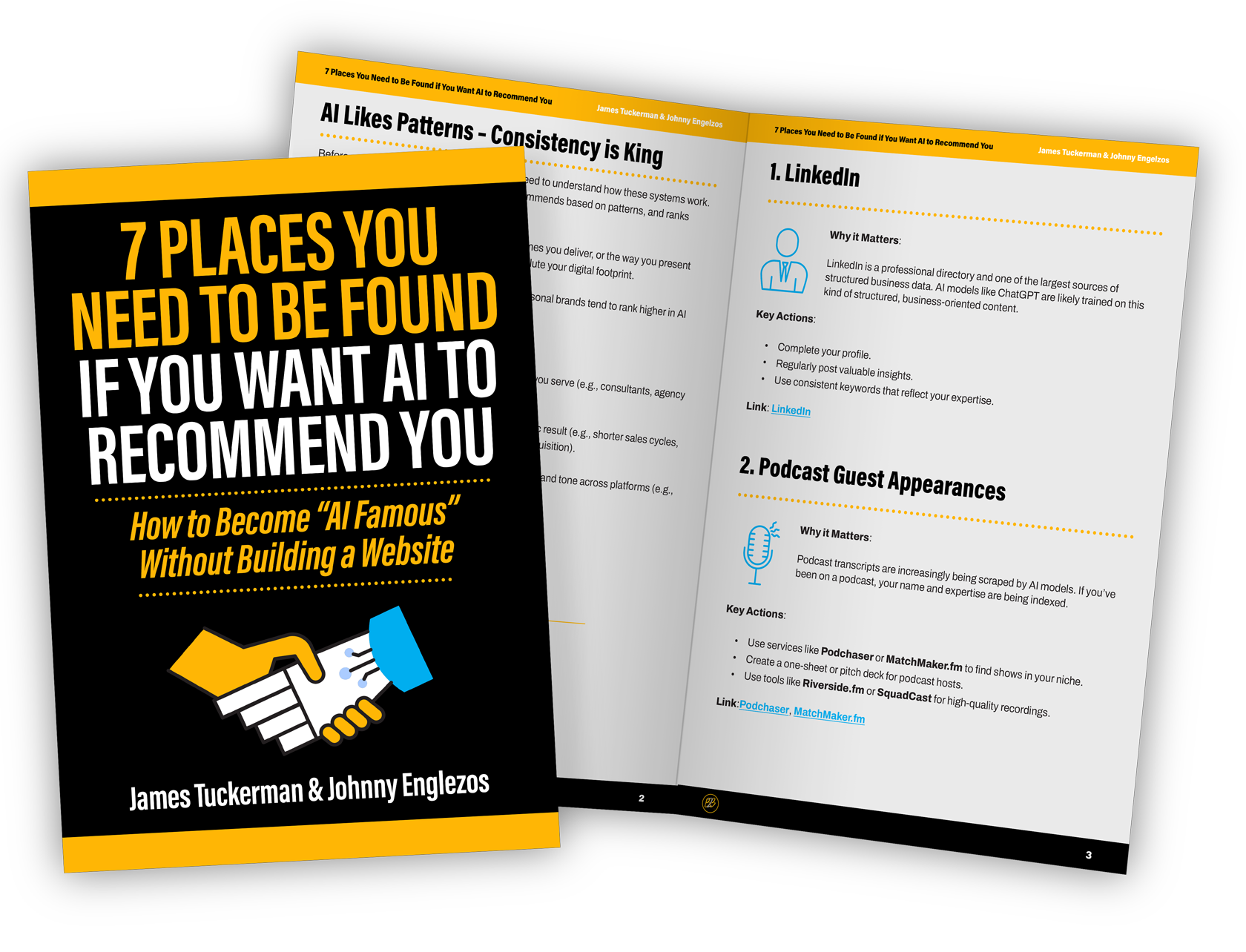
Want to be recommended by ChatGPT or Gemini? Learn the 7 places AI pulls data from—and how to show up where it counts. Download the free guide. By James Tuckerman
AI tools like ChatGPT, Google Gemini, and Claude are rapidly becoming the first place people turn for recommendations.
So if you want to be the go-to expert in your industry, the question isn’t just:
“Am I showing up in search engines?”
It’s: “Is AI recommending me to the right people?”
In this post, we’ll walk through the 7 online places you MUST be visible if you want to be recognized, featured, and recommended by AI — plus a free PDF that breaks it all down.
Why Does AI Visibility Matter?
AI is becoming the interface for search, buying decisions, and research. Whether someone’s looking for a service provider, expert, or resource — they’re increasingly asking AI.
But here’s the key: AI is pattern-driven. It recommends people and brands that show up consistently across structured platforms.
If you’re scattered, it won’t know what to say. If you’re consistent, it mirrors back your authority.
The Consistency Formula for AI Fame
Before diving into platforms, make sure your digital presence follows the 3 Consistency Rules:
- Audience Consistency: Be clear about who you serve (e.g., consultants, SaaS founders, advisors).
- Outcome Consistency: Be known for a specific result (e.g., shorter sales cycles, lead generation).
- Message Consistency: Use similar language and tone everywhere (e.g., direct, helpful, high-value).
7 Places You Need to Be Found If You Want AI to Recommend You
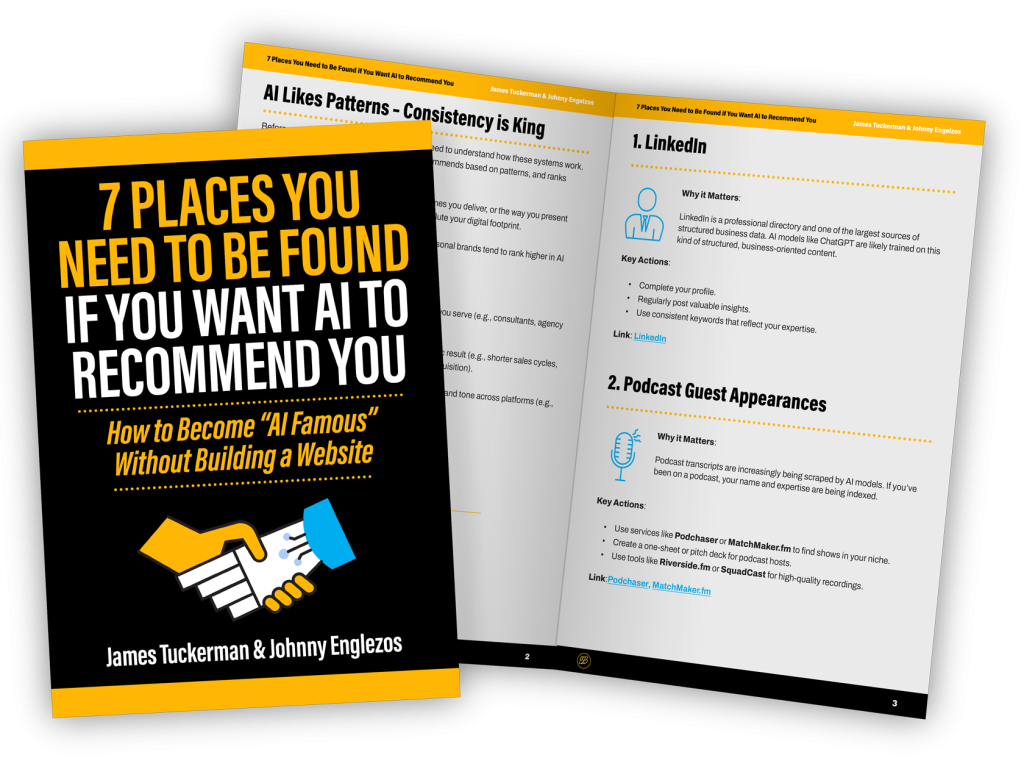
1. LinkedIn
Why it matters: It’s the most structured professional network — and a major source of data for AI.
What to do:
- Fully complete your profile
- Post valuable insights regularly
- Use keywords that reflect your expertise
2. Podcast Guest Appearances
Why it matters: Podcast transcripts are indexed by AI. Appearances = citations.
What to do:
- Use Podchaser or MatchMaker.fm to pitch shows
- Create a one-sheet with your bio and topics
- Record using tools like Riverside.fm for quality
3. YouTube (or Rumble)
Why it matters: Video content is training data for AI. Titles, tags, and descriptions are all scraped.
What to do:
- Start a channel focused on your niche
- Use SEO tools like TubeBuddy or VidIQ
- Post short-form content (YouTube Shorts)
4. Q&A Sites and Niche Forums
Why it matters: Quora, Reddit, and niche forums contain valuable context-rich content.
What to do:
- Answer questions on Quora or Reddit
- Join industry-specific groups or forums
- Stay on-brand and consistent
5. Digital Publications & Guest Posts
Why it matters: Credible articles and mentions build trust with AI.
What to do:
- Write for Medium, Substack, or niche blogs
- Use HARO to get quoted in media
6. Professional Directories & Databases
Why it matters: Structured data sources like Crunchbase help AI categorize you accurately.
What to do:
- Build profiles on Crunchbase, AngelList, Clutch
- Keep them updated and keyword-rich
7. Reviews and Testimonials
Why it matters: Social proof signals credibility and relevance to AI.
What to do:
- Collect reviews on Trustpilot, G2, or Google Business
- Use tools like Endorsal to gather and automate testimonials
Bonus: Build Your “Second Brain” for AI Content Creation
Once you’re visible across platforms, scale your impact with a Second Brain — a centralized database of your ideas and expertise that AI can pull from.
Use tools like:
- ChatGPT Custom GPTs
- Chatbase or Supabase for knowledge bases
- Pinecone for vector storage
- ElevenLabs to add your voice
This creates a content engine that feeds AI with your expertise consistently
Final Word: Be the Signal, Not the Noise
If you want AI to recommend you, you must be consistent and visible where it counts.
Pick one or two platforms to start, tighten your message, and layer in your Second Brain when ready.
🎯 Ready to be AI Famous? Download the full PDF here.
![Seven steps to get more from cloud tools [FREE CHEAT SHEET]](https://anthillonline.com/wp-content/uploads/2014/11/kavanagh-3D-cover1.png)
![How to zig when everyone else is zagging, with Julio De Laffitte [CHEAT SHEET]](https://anthillonline.com/wp-content/uploads/2015/08/Capture2.jpg)