James Tuckerman’s Hierarchy of B2B Needs: The 7 Levels of Business Growth
Why do some B2B businesses struggle despite working harder than ever? James Tuckerman’s Hierarchy of B2B Needs is a framework that reveals the seven levels of business growth and helps owners focus on solving the right problems at the right time.
Most business owners have heard of Maslow’s Hierarchy of Needs.
The idea is simple.
Humans tend to focus on certain needs before they focus on others.
A person struggling to find food and shelter isn’t usually spending much time thinking about self-actualisation.
Businesses work in a similar way.
Over the years, I’ve worked with thousands of B2B business owners.
Consultants. Agency owners. Coaches. Trainers. Professional service firms.
And I’ve noticed something interesting.
Many business owners are trying to solve problems that belong on Level 5 while they’re still struggling with Level 2.
For example, they might be obsessing over AI, automation and scale while still relying on luck and referrals for new business.
So I started thinking about what a hierarchy of business needs might look like.
That’s what led me to develop what I now call James Tuckerman’s Hierarchy of B2B Needs.
Here’s where I landed.
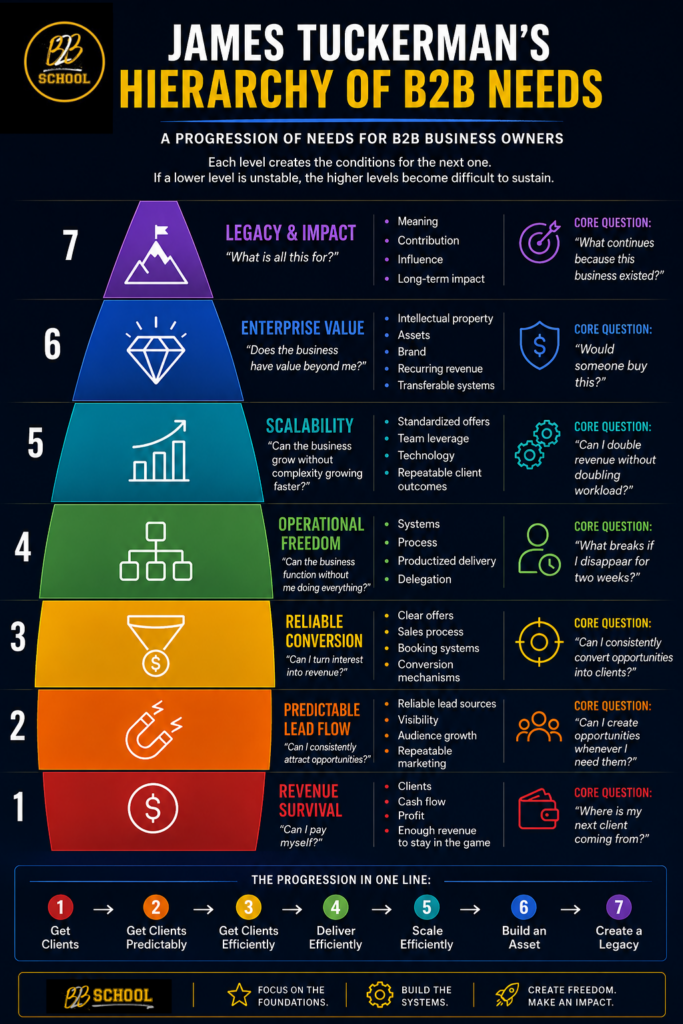
Level 1: Revenue Survival
Every business starts here.
At this stage, growth, systems, branding and strategy are largely irrelevant. The business simply needs enough paying clients to generate cash flow and prove that somebody is willing to exchange money for what you do. Most owners at this level spend a significant amount of time wondering where the next client will come from because the gap between winning one client and winning the next often feels enormous.
The dominant question is:
“Where is my next client coming from?”
Level 2: Predictable Lead Flow
Once the business can generate revenue, the next challenge is consistency. A handful of clients proves that the offer has value. The real challenge is creating a reliable way to generate opportunities without relying entirely on luck, referrals or random acts of marketing. This is where content, partnerships, networking, advertising and outbound activity start to matter because the business needs a system that creates conversations on demand.
The dominant question is:
“Can I create opportunities whenever I need them?”
Level 3: Reliable Conversion
Many business owners discover that generating attention and generating revenue are two very different things. They have meetings. They have enquiries. They have interested prospects. Yet revenue remains inconsistent because there is no clear path from interest to commitment. At this level, positioning, offers, sales conversations and booking systems become critically important because the business needs a repeatable way to turn opportunities into clients.
The dominant question is:
“Can I consistently convert opportunities into clients?”
Level 4: Operational Freedom
Success creates its own problems. Revenue increases, clients increase and opportunities increase. Unfortunately, the workload often increases as well. The owner becomes the central hub through which everything passes. Decisions, delivery, sales and client management all rely on one person. The focus at this level shifts towards systems, process, delegation and productisation because the business needs to function without the owner being involved in every activity.
The dominant question is:
“What breaks if I disappear for two weeks?”
Level 5: Scalability
Growth becomes far more interesting when the goal is no longer simply doing more work. True scalability occurs when revenue can increase faster than complexity. Businesses at this level focus on creating standardised offers, repeatable outcomes, technology leverage and operational efficiency. The objective is to create a business that can handle significantly more clients without requiring a proportional increase in effort, stress or headcount.
The dominant question is:
“Can I double revenue without doubling workload?”
Level 6: Enterprise Value
At some point the business starts becoming something larger than the founder. The value is no longer tied exclusively to the owner’s expertise, relationships or effort. Instead, the value begins to sit inside intellectual property, systems, brand equity, recurring revenue and transferable assets. Whether the owner intends to sell or not, the business starts resembling an asset rather than a job.
The dominant question is:
“Would someone buy this business?”
Level 7: Legacy & Impact
Eventually many business owners arrive at a stage where the conversation changes. Revenue matters. Growth matters. Profit matters. Yet a different question starts demanding attention. The owner begins thinking about contribution, influence and the long-term impact of the work they have spent years building. The focus shifts from what the business produces to what the business leaves behind.
The dominant question is:
“What continues because this business existed?”
“What was all this for?”
Where Are You Right Now?
So I’m curious…
Which level are you currently operating at?
And which level are you trying to reach next?
About James Tuckerman
James Tuckerman is a business strategist, speaker and co-founder of B2B School. Over the past two decades, he has helped thousands of consultants, coaches, agency owners and other knowledge professionals attract clients, simplify sales and build businesses that are less dependent on referrals, founder effort and one-to-one delivery.
![How much does your site search suck? [VIDEO]](https://anthillonline.com/wp-content/uploads/2012/12/WhiteProducts.jpg)


![How to become a master at content marketing with Gihan Perera [ACADEMY]](https://anthillonline.com/wp-content/uploads/2012/08/gihan.jpg)