How to Choose a Target Audience (The Definitive Guide)

Should you niche down?
It’s one of the most common questions I hear from consultants, coaches, agency owners, SaaS founders and other expert-led businesses.
On one hand, you’ve probably heard that “the riches are in the niches.”
On the other, choosing a niche can feel risky. What if you pick the wrong one? What if you turn away good opportunities? What if your market is too small?
Over the past decade, I’ve helped more than 1,000 expert-led businesses grow from $10,000 months to $30,000 months, $50,000 months, $100,000 months and beyond. During that time, I’ve reviewed thousands of websites, LinkedIn profiles, sales presentations and marketing campaigns.
And I’ve noticed one mistake that appears again and again.
People try to boil the ocean.
Imagine standing on a beach with a giant flamethrower. You could blast the ocean with fire for the next hundred years and it still wouldn’t boil. Now imagine placing a small saucepan of water over a tiny flame. Within minutes, it’s bubbling. Marketing works the same way.
The broader your audience, the more thinly you spread your attention. Your message becomes generic. Your marketing feels less relevant. Fewer people recognise themselves in what you do. Referrals become harder because nobody is quite sure who you’re looking for.
A clearly defined audience concentrates your effort. It allows you to speak your clients’ language, address the problems they face every day and become known for solving a specific type of challenge. Over time, that clarity compounds into stronger positioning, better referrals and faster growth.
The good news is that choosing a target audience isn’t a permanent decision.
It’s simply a decision about where to focus your marketing today.
In this guide, I’ll show you how to make that decision with confidence.
You’ll learn the three biggest audience selection mistakes I see almost every expert-led business make, a simple one-minute test to determine whether your positioning is clear and a practical three-step framework for choosing an audience that is easy to find, easy to understand and willing to spend money. By the end, you’ll have the foundations of an Ideal Client Profile that you can use across your website, LinkedIn profile, marketing, sales materials and even your AI prompts.
Prefer to watch? Here’s the full training (11 minutes).
Immediate Answer
If you’re looking for the short answer…
Yes, most expert-led businesses should niche down.
The goal isn’t to become smaller. The goal is to become clearer.
When your audience can immediately recognise themselves in your marketing, every part of your business becomes easier. Your messaging resonates more deeply, referrals become more precise, sales conversations start further down the track and your expertise carries greater weight.
The rest of this guide will show you exactly how to choose that audience—without relying on guesswork, gut feel or the fear of making the wrong decision.
Part 1: The Three Biggest Audience Selection Mistakes
After reviewing thousands of websites, LinkedIn profiles and marketing campaigns, I’ve noticed something. Most businesses don’t struggle because they’re bad at marketing.
They struggle because they make the same three audience selection mistakes.
If you can avoid these, almost every other marketing decision becomes easier.
Mistake #1: Trying to Boil the Ocean
The first mistake is choosing an audience that’s simply too broad.
People tell me they target:
- Business owners
- Professionals
- Small businesses
- Decision makers
On paper, that sounds sensible. The broader your audience, the more opportunities you’ll have.
Right? Nope.
Unfortunately, marketing doesn’t work that way.
Every business has a finite amount of time, money and attention.
The broader your audience, the thinner you spread those resources. Your message becomes more generic. Your content becomes less relevant. Your website starts speaking to everyone, which means it resonates deeply with almost no one. A narrower audience has the opposite effect.
Mistake #2: Confusing a Need with an Audience
The second mistake is much more subtle.
I ask:
“Who’s your target audience?”
And people reply:
- Businesses with long sales cycles.
- Companies that need a new website.
- Organisations looking for leadership training.
- Businesses that need more leads.
Those aren’t audiences.
They’re needs.
A need is something someone experiences.
An audience is someone you can identify.
For example:
❌ Businesses that need marketing.
✅ Accounting firms with 10 to 50 staff.
❌ Companies looking for HR support.
✅ Manufacturing businesses with 50 to 200 employees.
Can you see the difference?
Needs are invisible.
You can’t search LinkedIn for “businesses that need marketing.” You can’t attend a conference for “companies wanting more leads.” And you certainly can’t ask a referral partner:
“Do you know anyone who needs a new website?”
Observable characteristics are completely different.
- You can search for accounting firms.
- You can join their industry association.
- You can advertise in their trade publications.
You can ask someone:
“Do you know any accounting firms with 10 to 50 staff?”
That’s a referral people can actually make.
Always start by identifying who.
Later, you’ll define what problem they need solved.
Mistake #3: Targeting Mindsets Instead of People
The third mistake is describing your audience using personality traits.
People say things like:
- My ideal clients are ambitious.
- They’re growth-minded.
- They’re visionary.
- They’re purpose-driven.
- They’re high performers.
Those qualities might all be true.
They’re just not useful when you’re trying to choose an audience.
Again, you can’t search LinkedIn for “ambitious CEOs.” You can’t ask a referral partner:
“Do you know any purpose-driven founders?”
And you can’t buy advertising aimed at “high-performing business owners.”
Mindset matters. It just isn’t the best place to start.
Instead, begin with characteristics that anyone can observe:
- Industry
- Job title
- Company size
- Geography
- Business model
Once you’ve identified a clear audience, you’ll naturally begin to understand the attitudes, beliefs and motivations they share. That’s when mindset becomes valuable. Not before.
Three Mistakes. One Common Theme.
At first glance, these mistakes seem unrelated.
- One is about broad audiences.
- Another is about confusing needs with people.
- The third is about personality traits.
In reality, they all stem from the same underlying problem.
They’re all difficult to recognise.
Which raises an important question.
How do you know whether your audience is actually clear enough for others to recognise?
There’s a simple test I use with every client.
I call it The Doctor on the Plane Test.
Part 3: The Doctor on the Plane Test
So far we’ve established two important ideas.
First, broad audiences create broad marketing.
Second, a target audience should describe people you can actually identify, not invisible needs or personality traits.
But here’s the real question.
How do you know whether your audience is actually clear?
Over the years, I’ve found one simple thought experiment that answers this almost instantly.
I call it The Doctor on the Plane Test.

Imagine you’re sitting on a plane.
Halfway through the flight, a passenger suddenly collapses.
A flight attendant rushes into the aisle and shouts:
“Is there a doctor on the plane?”
What happens next?
Every doctor immediately knows whether they’re being called.
Other passengers also know exactly who should stand up.
There isn’t any confusion.
Now imagine the flight attendant shouted something different.
“Is there anyone who’s passionate about health and wellbeing?”
Suddenly the situation becomes ridiculous.
- Does that include someone who goes to the gym?
- Someone who eats organic food?
- A yoga instructor?
- A physiotherapist?
- Someone who bought a green smoothie at the airport?
Nobody knows.
The description is too vague.
That’s exactly what happens when businesses describe their audience using words like:
- Growth-minded.
- Ambitious.
- Innovative.
- Purpose-driven.
- Businesses that need marketing.
- Companies with long sales cycles.
Those descriptions may all be true.
They just aren’t recognisable.
People can’t identify themselves.
More importantly…
Other people can’t identify them either.
Great Positioning Creates Instant Recognition
The purpose of positioning isn’t simply to explain what you do.
It’s to help the right people recognise themselves immediately.
Imagine these two opening statements.
“We help businesses grow.”
Now compare that with:
“We help accounting firms with 10 to 50 staff generate more qualified B2B leads.”
One could describe almost anyone.
The other immediately tells an accounting firm whether they’re in the conversation.
That’s what you’re aiming for.
Your audience shouldn’t have to decode your marketing.
They should instinctively think:
“That’s us.”
Your One-Minute Test
Open your website. Look at your LinkedIn profile. Read the headline on your homepage.
Now ask yourself one simple question.
If my ideal client landed here today, would they immediately think:
“This person is talking about me.”
If the answer is yes…
You’re probably on the right track.
If the answer is maybe…
Or “sort of”…
Or “after they read the whole website”…
Then your audience probably isn’t specific enough.
If You Failed the Test…
Don’t worry. Most businesses do.
The good news is that audience selection isn’t about guessing. It’s a process.
In the next section, I’ll show you the exact three exercises we use with our clients to narrow their audience, validate their thinking and build an Ideal Client Profile.
Part 4: A Three-Step Framework for Choosing the Right Audience
By this point, you might already have an audience in mind.
Or perhaps you’re even more confused than when you started.
That’s completely normal.
Choosing a target audience feels difficult because most people approach it as a guessing game.
They ask themselves questions like:
- Who should I target?
- Which industry has the most money?
- Where’s the biggest opportunity?
Those aren’t bad questions.
They’re just the wrong place to start.
Instead of relying on intuition, we use a simple three-step framework that progressively removes uncertainty. Each exercise builds on the one before it.
- First, we eliminate the audiences that aren’t a good fit.
- Then, we look for evidence hidden in our past clients.
- Finally, we compare the strongest options using a simple scorecard.
By the end, you won’t just have a better idea of who to target.
You’ll have a documented Ideal Client Profile you can use across your website, LinkedIn profile, proposals, sales process and even your AI tools.
Let’s start with the exercise that almost nobody does.
Exercise 1: The Exclusion List
When people think about choosing a target audience, they usually begin by asking:
“Who do I want to serve?”
I’d encourage you to start somewhere completely different.
Ask yourself:
“Who don’t I want to serve?”
This simple shift changes the entire exercise.
Instead of trying to invent your perfect client from scratch, you begin removing the audiences that consistently drain your time, energy or profitability.
Think about the clients you’ve worked with over the years.
- Which industries never seemed to value what you do?
- Which projects always took longer than expected?
- Who negotiated every invoice?
- Who expected unrealistic outcomes?
- Who simply wasn’t enjoyable to work with?
Start writing them down.
Don’t worry about hurting anyone’s feelings.
This isn’t a public document.
It’s a thinking exercise.
You might discover that you don’t enjoy working with:
- retailers
- hospitality businesses
- government departments
- start-ups
- sole operators
- heavily regulated industries
- organisations below a certain size
- businesses above a certain size
Or perhaps your exclusions are based on something else entirely.
The point isn’t to create the smallest possible audience.
The point is to create clarity.
Every audience you remove makes the remaining options easier to see.
Why Exclusion Works
At first, excluding potential clients feels uncomfortable.
Most business owners worry they’re reducing their opportunities.
In practice, the opposite often happens.
When people understand who you don’t serve, they gain greater confidence in who you do serve.
Imagine walking into an Aston Martin dealership.

Before discussing the car, the salesperson asks where you’ll keep it. If you don’t have somewhere secure to store it, they may decide not to sell you one.
That sounds counterintuitive.
Yet it strengthens the perception that Aston Martin isn’t trying to sell to everyone.
Exclusion reinforces exclusivity.
The same psychology applies to positioning.
When you say:
“We only work with expert-led B2B businesses.”
Or:
“We’re not the right fit for retail businesses.”
The businesses you do serve feel more certain you’ve built your service around them.
Your positioning becomes stronger because your audience becomes clearer.
Your Action Step
Take a blank sheet of paper and write the heading:
Who We Don’t Serve
Start broad.
Then keep asking yourself:
“Who specifically does that not include?”
Every answer will sharpen your thinking.
Don’t aim for perfection.
Aim for progress.
In the next exercise, we’ll use your existing client base to validate those instincts with real evidence.
Part 5: Stop Guessing. Start Looking for Evidence.
The evidence you need is often hidden in your CRM.
- It’s hiding in your invoices.
- It’s buried in your case studies.
- It’s written all over the clients you’ve already helped.
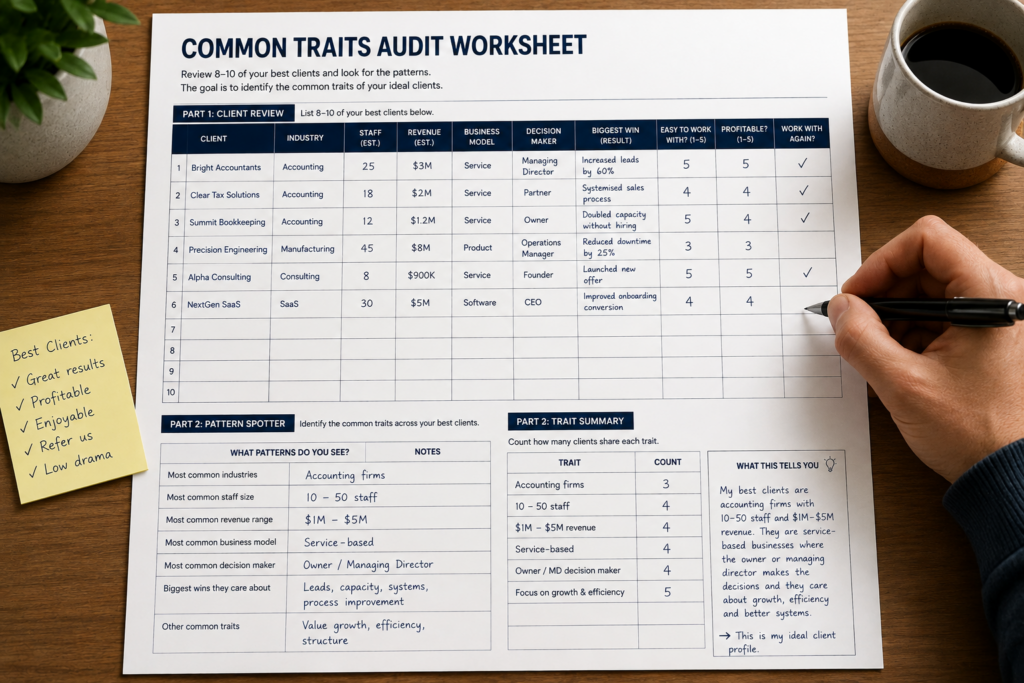
That’s why the second exercise is called the Common Traits Audit.
Instead of inventing an ideal client, you’re going to investigate the ones you’ve already worked with.
Your Best Clients Are Trying to Tell You Something
Think back over the past three to five years.
Who were your favourite clients?
Not just the ones who paid the most.
Think about the clients who ticked several boxes.
- They achieved great results.
- They were enjoyable to work with.
- They respected your expertise.
- They made decisions in a reasonable timeframe.
- And, ideally, they were commercially valuable.
Now make a list of five to ten of those clients.
Don’t analyse them yet.
Just write them down.
Look for Observable Patterns
Now comes the interesting part.
Go through each client and record as many observable characteristics as you can.
For example:
Organisation
- Industry
- Company size
- Approximate revenue
- Business model
- Geographic location
Decision Maker
- Job title
- Level of seniority
- Business owner or employee
- Department
Commercial Fit
- Results achieved
- Profitability
- Ease of working together
- Overall enjoyment
At first, each client may seem completely different.
But once you’ve documented several of them, patterns almost always begin to emerge.
The Gold Isn’t in One Client
Many people hope they’ll discover a single perfect client they can copy.
That’s rarely what happens.
Instead, the magic appears in the overlap.
- Perhaps four of your favourite clients were engineering firms.
- Maybe seven out of ten had between 20 and 100 employees.
- Perhaps nearly all of them sold complex B2B services.
- Or maybe every decision-maker was the founder or managing director.
Individually, none of those details seem especially important.
Collectively, they tell a compelling story.
You’re no longer choosing an audience based on intuition.
You’re identifying one based on evidence.
That’s a much stronger foundation for your marketing because it’s grounded in real commercial success rather than wishful thinking.
Your Action Step
Choose five to ten of your best clients from the past three to five years.
Create a simple table and record:
- Industry
- Company size
- Revenue (if known)
- Business model
- Decision-maker
- Location
- Results achieved
- Profitability
- Ease of working together
- Overall enjoyment
Then step back and look for recurring themes.
Don’t force a conclusion.
Simply ask:
- Which industries appear more than once?
- Which job titles keep showing up?
- Are there similar company sizes?
- Are there common business models?
- Which clients achieved the best outcomes?
- Which clients would I happily work with again tomorrow?
The answers will often surprise you.
And they’ll give you something far more valuable than a hunch.
They’ll give you evidence.
In the next section, we’ll combine that evidence with a simple scoring system to decide which audience represents the strongest opportunity for your business.
Part 6: Choosing Your Target Audience
By now, you’ve probably narrowed your options down to a handful of potential audiences.
Maybe you’re deciding between accountants and lawyers.
So…
How do you choose?
Many business owners make this decision based on gut feel. They choose an audience because they know someone in that industry. Because they enjoyed one particular project.
Or because they think a certain market “looks promising.”
There’s nothing wrong with intuition.
But intuition becomes much more powerful when it’s supported by evidence.
That’s why the final exercise is the Audience Selection Scorecard.
Instead of asking, “Which audience feels right?”, you’ll ask a much better question:
“Which audience gives my business the greatest chance of success?”
The Five Criteria
Take each audience you’re considering and score it out of five across the following criteria.
1. Players With Money
Do they actually have the budget to buy what you sell? This sounds obvious, but it’s amazing how often businesses build their marketing around audiences that simply can’t afford their services. A brilliant offer aimed at the wrong market will always struggle. You’re looking for organisations that already invest in solving the problem you address.
2. Proof
Do you already have credibility with this audience? Perhaps you’ve worked in the industry. Maybe you have testimonials, case studies or years of experience helping similar businesses. The more proof you already have, the easier your marketing becomes because you’re building on existing trust rather than starting from scratch.
3. Speed
How quickly do they make decisions? Some industries move incredibly fast. Others require months of meetings, committees and procurement processes before anything happens. Neither is inherently good or bad. But understanding buying speed helps you choose an audience that matches the type of business you want to build.
4. Findable
Can you actually reach them? Can you search for them on LinkedIn? Do they belong to industry associations? Do they attend conferences? Do they read the same publications? Do they listen to the same podcasts? The easier your audience is to find, the easier it becomes to market consistently.
5. Energy
Finally, ask yourself one simple question. Do I genuinely enjoy working with these people? This criterion is often overlooked. Yet it may be the most important. Building a business means spending years talking to the same types of clients. If you don’t enjoy those conversations, your enthusiasm will eventually disappear. Choose an audience that energises you. Not one that drains you.
Let the Numbers Guide You
Once you’ve scored each audience, total the results.
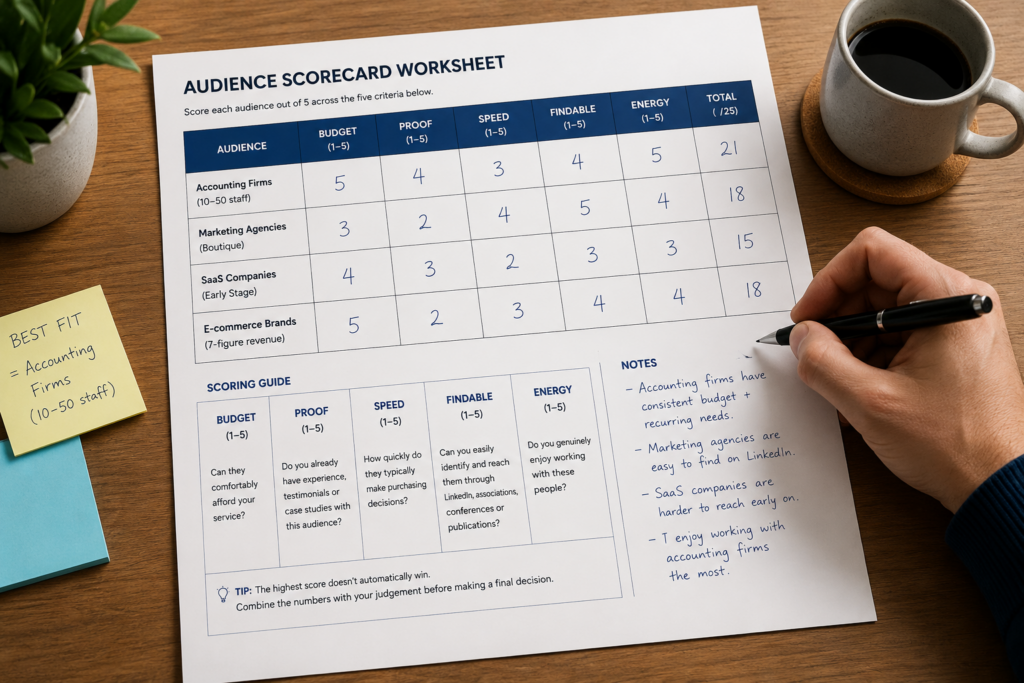
The highest score doesn’t automatically win.
But it does give you an objective starting point.
Instead of relying solely on instinct, you’ve combined:
- your experience
- your client history
- commercial reality
- personal preference
into a structured decision-making process.
That’s a far more reliable way to choose a target audience than chasing the latest trend or following generic advice.
Part 7: Turn Your Answers Into an Ideal Client Profile
By this point, you shouldn’t just have a better idea of your target audience.
- You should have evidence.
- You’ve eliminated the audiences that aren’t a good fit.
- You’ve analysed your best clients.
- You’ve compared your strongest options using objective criteria.
Now it’s time to bring everything together.
That’s where your Ideal Client Profile (ICP) comes in.
An ICP isn’t simply a description of your favourite customer.
It’s the document that aligns every part of your business.
Instead of making marketing decisions from memory, assumptions or gut feel, you now have a single source of truth that answers one of the most important questions in business:
Who are we trying to reach?
Your ICP Should Answer These Questions
A good Ideal Client Profile should include information such as:
- Which industries do we serve?
- What size organisations are the best fit?
- Who is the decision-maker?
- What business model do they operate?
- Where are they located?
- What observable characteristics define them?
- Who are we not a good fit for?
- What problems do they typically experience?
- Why do they choose to work with us?
Notice the order.
It starts with who.
Only then does it move to what problems they need solved.
That sequence keeps your positioning grounded in observable reality instead of vague assumptions.
One Document. Hundreds of Uses.
Most people think an Ideal Client Profile is something you create once and forget.
In reality, it’s one of the most valuable strategic assets your business can have.
Your ICP should influence:
- your website copy
- your LinkedIn profile
- your content strategy
- your advertising
- your sales presentations
- your proposals
- your referral conversations
- your onboarding
- your product development
- your AI prompts
Every time you create a piece of marketing, the first question should be:
“Would my Ideal Client immediately recognise themselves in this?”
If the answer is yes, you’re far more likely to capture attention.
If the answer is no, your message probably needs more focus.
Your AI Is Only as Good as Your Context
One of the biggest changes in marketing over the past few years has been the rise of AI.
Businesses are asking ChatGPT, Claude and Gemini to write emails, generate content, create LinkedIn posts and even build marketing campaigns.
But AI has the same problem humans do.
If you give it a vague audience, it produces vague marketing.
If you tell AI:
“Write an email for business owners.”
You’ll get something generic.
If you tell it:
“Write an email for managing directors of accounting firms with 20 to 100 staff who rely heavily on referrals.”
The quality of the output improves dramatically.
The clearer your Ideal Client Profile becomes, the better every AI tool will perform because you’ve removed ambiguity before the writing even begins.
Positioning Is Never Finished
Your Ideal Client Profile isn’t carved in stone.
As your business grows, you’ll learn more.
- You’ll discover new patterns.
- You’ll identify better clients.
- You’ll refine your positioning.
That’s exactly how it should work.
Think of your ICP as a living document.
Review it regularly. Update it whenever you notice a new trend. Every improvement makes your marketing a little more relevant. Every refinement makes referrals a little easier. Every insight helps you become a little more memorable.
And over time, those small improvements compound into a business that’s known for solving a specific problem for a specific group of people.
Part 8: Frequently Asked Questions
Should I niche down?
For most expert-led businesses, yes.
A clearly defined target audience makes your marketing more relevant, your referrals more specific and your positioning stronger. Rather than trying to appeal to everyone, you become the obvious choice for a particular group of people.
Remember, choosing a niche isn’t a lifetime commitment. It’s simply a decision about where to focus your marketing today.
Can I still work with clients outside my niche?
Absolutely. Your target audience defines your marketing, not your entire business. If an existing client wants additional work, say yes. If a great referral comes along, say yes.
If someone outside your target audience reaches out and they’re a fantastic fit, say yes.
Your niche simply tells you where to direct your marketing effort.
How narrow should my target audience be?
A good audience should be specific enough that people immediately recognise themselves.
For example:
❌ Small businesses
❌ Business owners
❌ Companies needing marketing
Better examples include:
✅ Accounting firms with 10–50 staff
✅ Independent schools
✅ Manufacturing businesses with 50–200 employees
Your audience doesn’t need to be tiny.
It needs to be recognisable.
Should I niche by industry or by problem?
Start with observable characteristics. Industries, company size, job titles and business models are much easier to identify than invisible problems or personality traits.
Once you’ve chosen an audience, you can then define the specific problems you solve for them.
What’s the difference between a target audience and an Ideal Client Profile?
Your target audience is the group of people or organisations you want to attract. Your Ideal Client Profile (ICP) is the document that describes that audience in detail. Think of the audience as the destination. The ICP is the map.
What if I have no clients yet?
Start with educated assumptions.
Think about:
- industries you understand
- people you enjoy working with
- businesses that can afford your services
- markets you can easily reach
As you gain experience, revisit your ICP and refine it using evidence rather than assumptions.
Can I target more than one audience?
Eventually, yes. Initially, it’s usually better to focus your marketing on one audience. That concentration helps you build stronger messaging, collect more relevant case studies and become known for solving a particular problem.
Once you’ve established credibility, expanding becomes much easier.
How often should I review my Ideal Client Profile?
Review it whenever you notice meaningful changes. Perhaps you’ve entered a new market. Maybe your favourite clients have changed. Or you’ve discovered a more profitable audience. Many businesses find an annual review is enough. Others update it every six months.
The important thing is that it remains a living document rather than something that’s forgotten after one workshop.
Is choosing a niche risky?
Most people think choosing a niche limits opportunity. In practice, the bigger risk is trying to market to everyone. Broad positioning makes it harder for people to recognise themselves in your marketing.
Specific positioning makes your expertise easier to understand and easier to recommend.
What’s the biggest audience selection mistake?
Trying to solve a problem for everyone. The broader your audience, the more diluted your marketing becomes. Clarity creates relevance. And relevance attracts attention.
Final Call to Action
If you’ve made it this far, you’ve already done something most business owners never do.
You’ve stopped guessing. You’ve started thinking strategically about who your business is really built to serve. Now don’t leave this as an interesting idea. Complete the exercises. Build your ICP.
Then use it.
- Update your website.
- Refine your LinkedIn profile.
- Rewrite your sales material.
- Feed it into your AI tools.
And most importantly…
Test it.
Because positioning isn’t something you perfect in an afternoon.
It’s something you improve through real conversations with real clients. The clearer your audience becomes, the easier every other part of marketing becomes. And that’s why choosing the right target audience is one of the highest-return decisions you’ll ever make for your business.
James Tuckerman is a B2B marketing strategist, business coach and co-founder of the B2B School. He specialises in helping consultants, coaches, agencies, SaaS companies and other expert-led businesses improve their positioning, generate predictable B2B leads, shorten sales cycles and build scalable client acquisition systems. Over the past decade, he has helped more than 1,000 businesses grow through practical marketing, sales and AI frameworks.