
Want to get your business featured in Anthill?

img

Often customers don’t want to be wowed – they want to be ‘not dissatisfied’

There isn’t just satisfaction and dissatisfaction, there’s non-satisfaction and non-dissatisfaction too. It’s important to know the difference.

I did some research once on bank customers and found out that they weren’t hoping for satisfaction, just no dissatisfaction. And it really made me think.

Some things satisfy:

  • Food
  • Entertainment
  • Travel
  • Sports
  • Friends
  • Dancing

Some web businesses satisfy:

And some things you just want to not be noticed;

  • Cleaning
  • Banking
  • Administration
  • Paying bills

Some web businesses are about ‘not-dissatisfying’;

  • Online backup
  • Live In Australia (online visas – though when you get the visa you’re very happy)
  • Google Docs
  • Search?

When was the last time you said “Wow, this hotel room is so clean – I’m really happy!”

Here is a bit of a chart to show you what I mean:
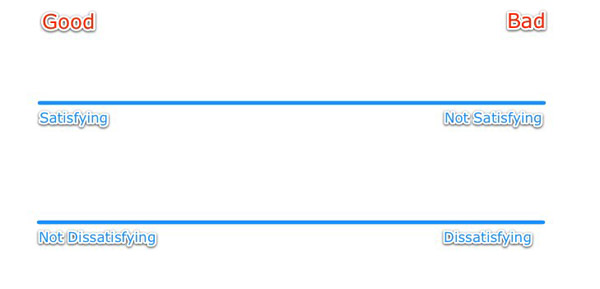
m liubinskas satisfying diagram 600w Often customers don’t want to be wowed – they want to be ‘not dissatisfied’

It’s useful to think of your product and features according to these. Is this feature going to make them happy or is it just going to make them mad if it doesn’t work? Of course, this is all in the eye of the beholder, so perception is everything here.

“But what about focus?”

Yes, focus is key here. Can you imagine if you put more than one type of customer on this chart and tried to keep them all happy? You can’t. Start with one, make them very happy AND not unhappy, then move on.

Your Turn

Mick Liubinskas is one of Australia’s leading web strategists, having served in head marketing roles at Kazaa, Zapr and Tangler. He now runs Pollenizer, the business incubator he co-founded with former-Kazaa colleague Phil Morle.

This post was first published on the Pollenizer blog.

Telstra Business Catalogue – Out Now

Want an ad like this?

Introducing:

  • Australia’s 1st 4G Samsung phone: Samsung Galaxy SII 4G
  • Australia’s 1st 4G tablet: Samsung Galaxy Tab 8.9 4G
  • The latest Windows® Mobile 7.5  Phone and a free 60 day trial of Microsoft® Office 365

Click here for more.....

  • http://www.shelbyblue.com Paul Groth

    Hi Mick,

    I agree with your point of Cleaning, Banking, Administration and Paying bills being something you don’t want to notice, however, when you’re comparing changes in service ‘how they used to be’ or ‘how you expect them to be (because of past experience)’ – there’s a big difference when a positive change is made, both immediately and long-term.

    If you are in control of the situation and you provide a service that’s ‘not dissatisfying -, that’s great and people can get on with their day without a negative experience. However, if for the small amount of time that your customer interacts with you in these situations, you (as their host) should find it beneficial to both of you to make the customer feel like they’ve just done their ‘usually boring’ trip to the bank and come out with great big smile and feeling really good about themself. A few interactions in a row like that and they could even start to look forward to their daily or weekly bank visit.

    I just remembered a slogan from way back ‘we make banking fun’, I can’t remember which bank said that but I’m wondering if it actually was ‘fun’ at that bank? I wonder how they define the word ‘fun’ anyway?

    I can see how your theory makes sense but in any situation I would always try to improve the service beyond a level of ‘not dissatisfying’. And yes, I agree that it’s very hard to satisfy everyone, although I do like to think it’s possible.

    Paul Groth
    http://www.shelbyblue.com
    http://www.marketingmixer.com.au

    [Reply]

  • http://www.interaction-dynamics.com/blog Matt Leeburn

    Mick,

    I like your post.

    I think you are right in that aiming to satisfy or simply to not dissatisfy can work. But I also believe that this is entirely dependant on the type of product/service/business that you have.

    In a blog I wrote a couple of months ago called Benchmarking Satisfaction (http://interaction-dynamics.com/blog/2010/01/benchmarking-satisfaction/) I argued that the satisfaction received by the product/service isn’t always dependant on the product/service itself. Human beings tend to benchmark satisfaction against a range of attributes, making it relative to something else.

    In the post I discussed that when people evaluate an experience, they are performing one or more of the following comparisons:

    1. Comparing the experience to what they hoped it would be
    2. Comparing the experience to what they expected it to be
    3. Comparing the experience to other experiences they have had in the recent past
    4. Comparing the experience to experiences that others have had

    Each of these comparisons makes the evaluation of an experience relative, and this may diminish the experience or enhance it.

    So I think when looking at creating a strategy to satisfy/not dissatisfy, you also need to think about where a person’s benchmark may be set.

    [Reply]

  • http://www.smartink.com.au Peter

    In the case of the banks, is it just because we’re so used to being disappointed with them that we’ll accept not being dissatisfied as a “win” of sorts?

    [Reply]

  • http://www.madinmelbourne.com.au Dale

    Add into the equation the mini survey at the end of the call, were you happy with the quality of the call? Yes, and I’d be happier if you didn’t ask. Are they checking to satisfy potentially dis satisfied clients? I’d prefer if CS agents 1.. answered the phone within 4 rings, 2. answered MY questions ultra quick, 3. stopped putting me on hold for periods of more than 2 minutes and 4. didn’t ask if I was satisfied with the call. Big corps cutting into my valuable time to develop my business are a NO-NO…. hhhmmm…. suppose I could say that next time a CS agent asks… or invoice them for my valuable time if they really want the answer to that question.

    [Reply]

  • http://YourWebsite CitySlicker

    One of our SaaS clients said the same thing: “We don’t notice when things are good, just when things are bad. In fact your high performance can be a problem … it raises the bar for those areas of our business that don’t use your system.”
    It’s an argument that says that if you have time to improve what you do, focus on improving reliability rather than gold plating the service (though our pride in our product means that we spend 50% of our effort constantly working on improving the product).
    Recalling my time at a major bank some 12+ years ago, they spent a lot of money adding an extra “9″ to their reliability (1 – probability of failure) and not much on minimising the consequences of failure. Basically, try to avoid a problem as much as possible, but be better prepared if a problem occurs.

    [Reply]

blog comments powered by Disqus

Find Us on facebook

Latest Video

Waiting for the great leap forward? I think it’s already here [VIDEO]

Throw away your keyboard. Discard your mouse. All you need to do to control your computer is wave your hands about. No instruction manual needed, just a teeny, tiny device that reads your hand motions. Really. The revolution in human-computer interaction just took a massive leap forward.

More>>

Latest Comments

Ant Mart

Anthill Amabassadors

Anty-Climax

Sponsored by Antmart

It’s a group buying site specifically created for entrepreneurs and business builders.

More>>

thumb

Tech & Innovation

Sponsored by AusIndustry

AusIndustry is a specialist program delivery division within the Department of Innovation, Industry, Science and Research.

More>>

thumb

Marketing & Media

Sponsored by Google

What do you know about Google AdWords? This hub was developed to answer the questions you already have, and those you haven’t thought yet to ask.

More>>

thumb

Growth & Export

Sponsored by How to become a Key Person of Influence

Key People enjoy a special status in their chosen field because they are well connected, well known, well regarded and highly valued.

More>>

thumb

Upcoming Events

MAY
29

Want more leads and customers? Half day event to get big outcomes from a little budget.

Have you ever wondered… Why every industry has only a few businesses that thrive and get more leads? And they don’t suffer from cash flow problems or lack of leads, even when there is an ‘economic downturn’. They don’t have to ‘push’ or make stacks of cold calls.

More>>

MAY
22

WEBINAR: How to turn your knowledge into products… and build a global empire in your underpants!

This webinar is all about how to unlock your valuable industry knowledge and turn it into a product. It’s about how to increase the value of your business and take control of its future.

More>>