
This article is the second in our Australia Day series. Over the next few weeks, we’ll be taking a close look at Commercialisation Australia, the proposed R&D tax incentive reforms and how these reforms match (or conflict) with the political language used to promote them. But to begin with, let’s start with the basics. Can Australia really claim to be a nation of innovators?
Also in this series…
Part 1: Australian Innovation Policy… Where the bloody hell are you?
Part 2: Can Australia really claim to be a nation of innovators?
Part 3: The proposed Australian R&D tax reforms… Do they walk the talk?
Part 4: Would you like to be CEO of Commercialisation Australia?
Can Australia really claim to be a nation of innovators?
Innovation is among the most powerful influencers of economic growth.
Naval innovation gave the Portugese and Spanish their commercial edge in the 1400s. Agricultural and industrial innovation were largely responsible for Britain’s economic dominance for most of the past three hundred years. Innovation is what propelled the USA into its position as a world power during the twentieth century. Innovation was the fuel that turned war-ravaged Japan into a technological powerhouse and resource-poor Finland into a telecommunications leader. Innovation is what continues to transform emerging economies, such as India, South Korea and Thailand. Innovation is what will power China’s growth for decades to come. Innovation is the force that drives economic prosperity…
…unless you live in Australia.
Why Australia is not an innovative nation
In Australia, we like to believe that we are highly innovative.
We cite examples, such as the Stump Jump Plough, the wine cask, the plastic banknote, the Victor Mower and, everyone’s favourite, the humble Hill’s Hoist. Those with a bent for more recent technology advancements will mention the Cochlear Implant and maybe even the Speedo Bodysuit.
Asked to name any further examples and most Australians will start to struggle.
Sure, we’ve reared more Nobel Prize Laureates in Science than any other nation on the planet. But ask your average shopper in New York, Beijing or Helsinki to name an Australian product and you might find yourself waiting a long time for an answer.
So, is Australia a nation of innovators? For a country of our size and natural assets, are we punching above or below our weight?
How to measure innovation
In September 2008, Australia’s Minister for Innovation, Senator Kim Carr, gave a speech to coincide with the launch of Venturous Australia, a review of the Australian innovation system, commissioned by the Minister and prepared by esteemed innovation academic Dr Terry Cutler.
At this time, the Minister for Innovation had this to say:
“Between 1995 and 2004, Australia was one of only three OECD countries to reduce its tax benefits for business R&D – and of those three, our cuts were the deepest. During the same period, sixteen OECD countries increased their level of support…. In the nine months since Labor came to office, New Zealand, the United Kingdom, France, Belgium, the Netherlands and Spain have all introduced or extended tax incentives for business R&D. Japan and the United States have flagged their intention to do likewise.”
While there are countless papers and research reports orbiting the globe on the very topic of measuring and quantifying innovation, it is worth mentioning at the outset that the Federal Government clearly considers tax benefits for business R&D to be a good indicator of a country’s commitment to innovation (based on this and other quotes).
It turns out that most of the experts agree.
Who’s carrying innovation, now?
In September 2003, as the cover story of Anthill’s very first print magazine edition, I asked this very question: Who’s carrying innovation? Without realising it, I had created a benchmark – a source that to I could go back to and periodically measure our progress.
 In this article, I made arguments that today sound passé and obvious.
“Australia can no longer compete on cost and quality alone. No matter how hard we try, chances are we’ll be pipped at the post by competing nations with equal access to global markets, cutting-edge technologies and significantly lower labour costs.”
The answer, I argued, was to increase our “innovation capacity”.
This term was new to me at the time of writing, heavily influenced by the work of American innovation theorist Scott Stern and Melbourne Business School Academic Joshua Gans. Yet the concept of a nation’s “innovation capacity” is now a decade old.
Around 1999, a body of research on the stimulators and determinants of innovation at a national level began to form in many countries across the globe. It may have been triggered by the rampant success of the dotcom/technology boom of the late nineties.
But, more likely, it was simply time.
Innovation is about more than lodging patents
Advanced nations were becoming increasingly aware of their inability to compete on cost and quality alone. The National Innovation Index Project was one attempt to find an answer. Launched at the Council of Competitiveness in the USA, headed up by Michael Porter and the aforementioned Stern, its goal was to identify the key drivers of innovation.
Rather than simply relying on the number of international patents lodged or the number of scientific papers published, Porter and Stern looked at the broader picture, creating the concept of “common innovation infrastructure” and the importance of linkages between it and a “cluster-specific environment for innovation.”
Gauging a country’s ‘innovation capacity’, they said, required a weighted range of measures such as national R&D expenditure, supply of risk capital and a number of other determinants that could be used to reflect the actual resource and policy commitments of a country and not simply a country’s propensity to patent.
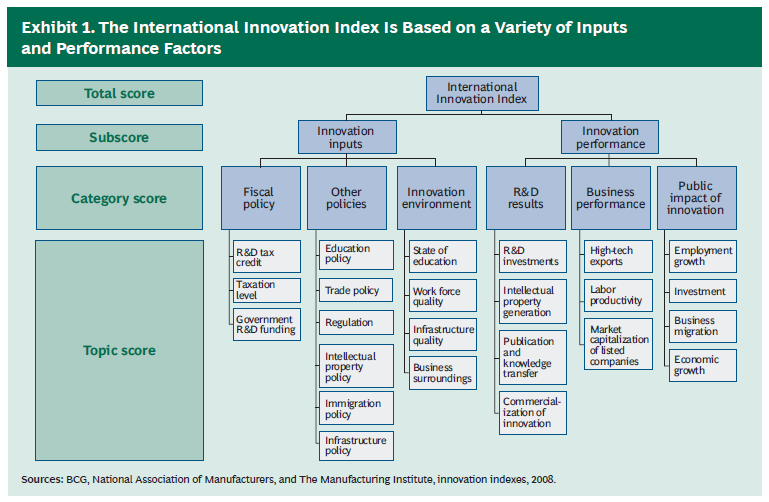
This type of thinking has since guided most well-established methodologies for ranking a nation’s innovation capacity. Today, the Innovation Index Project has developed into an ongoing line of research and is an annual component of the World Economic Forum’s Global Competiveness Report. Its structure of innovation inputs and outputs is also used by The Boston Consulting Group (BCG), the National Association of Manufacturers (NAM) and The Manufacturing Institute (MI) to create the Global Innovation Index.
Importantly, it is worth mentioning that each of these reports acknowledge that innovation is not simply about coming up with new ideas. It is about the commercial development of incremental improvements and the creation of new-to-world technologies.
In other words, innovation is not the R&D you do, but what you do with the R&D.
Innovation inputs and outputs
So, is innovation a driver of economic development down-under? The simple answer is, yes. But is it a core driver — part of our national psyche, supported by government policy?
I personally don’t think that it is.
According to the Federal Government in Power Ideas – An innovation Agenda for the 21st Century:
“In the last eight years, Australia has slipped from fifth to eighteenth in the World Economic Forum’s Global Competitiveness Index. We are even further back on capacity for innovation, ranking twenty-ninth.”
While Australia safely ranks among the ‘teens’ with respect to most of the important indexes, and indeed it sometimes even scores a single-digit ranking when measured against OECD countries, many of the measures used by these international monitors are gauged against infrastructure inputs, such as a consistent legal and IP protection systems, free trade policies and robust education systems.
Below is a chart that outlines the inputs and performance outputs used by the Global Innovation Index to rank nations.
As such, it’s not hard to rank highly on an innovation or competitiveness index if your country has the right infrastructure inputs — i.e. once your country has achieved a relatively advanced stage of economic development.
At the same time, however, it should be acknowledged that advanced nations are also the most susceptible to loss of trade (and therefore competitiveness) because of these factors. Advanced economies with these and other infrastructure outputs usually offer a high quality of living that is generally accompanied by a parallel increase in labour costs.
Unless the negative affects of rising labour costs on an economy can be offset by an increase in its innovation performance, usually characterised by high-tech exports and commercialisation outputs, most countries will suffer.
This is technically and historically accurate…
… once again… unless you live in Australia.
Why think when you can dig?
When attempting to justify our ‘highly innovative’ culture, it seems all too easy to call upon our convict roots and start citing necessity as the mother of invention (and all that). I’ve seen this speech delivered by politicians on more occasions that I’d like to recollect (usually accompanied by another definition of innovation).
But the truth is, I’m not so sure that ‘necessity’ is a part of life for most Australians. I don’t think that the ‘tyranny of distance’ still forces us to work smarter, not harder. In fact, the only cultural description I believe worth citing as part of this innovation debate is Australia’s reputation as a ‘lucky country’.
As a nation, we’re spoilt.
Whereas most advanced economies are vulnerable to an economic backlash once a certain level of economic development is achieved — a backlash that can usually only be overcome by improvements in a nation’s innovation performance — Australia has managed to overcome this dependence on innovation that dictates the economic policies and fate of most advanced nations.
Take this chart from IBISWorld:
Australia’s top export industries
* All figures are in $ billion
| Industry | Industry Revenue | Value of Exports | 5 Year Export Growth | |||
| 2009-10 | 2014-15 | 2009-10 | 2014-15 | 2005-10 | 2010-15 | |
| Agriculture | $68.5 | $74.4 | $18.1 | $21.4 | 1.7% | 3.4% |
| Mining/Resources | $283.7 | $322.8 | $128.0 | $172.0 | 2.6% | 6.1% |
| Manufacturing | $246.9 | $270.4 | $29.0 | $33.0 | 1.8% | 2.6% |
| Education | $77.2 | $92.9 | $8.1 | $11.1 | 3.8% | 6.7% |
| Tourism | $79.2 | $85.8 | $23.9 | $23.4 | 1.6% | 4.2% |
| Other | $356.5 | $478.8 | $30.8 | $59.3 | 6.1% | 14% |
| GDP | $1,112.0 | $1325.0 | $237.9 | $326.2 | 3.6% | 6.5% |
The first observation that can be taken from this report is that mining revenues account for approximately 25% of our GDP.
One of the main reasons that Australia weathered the GFC better than many other countries is that China began buying our resources in far greater volumes than ever before at the exact time that many of our other ‘customers’ stopped shopping with us altogether (namely Europe, Japan and the US). Had China not continued to boom and consume, our export earnings would have taken a real beating. So we got through the downturn in Europe on the back of China. But what happens next?
The business of export
I look at the Australian economy as I do my own company. When one source of my trade (i.e. one ‘customer’ or ‘product line’) exceeds a certain percentage of all my trade (say over 25 percent), I start to worry. This is because it if I lose that one source, I’m in deep doo-doo.
It concerns me that Australia has such a vested interest in the one ‘product line’.
Indeed, I’d also be curious to learn how much of our GDP can be attributed to the one ‘customer’. For example, if we lose that one product stream or that one customer, do we stand to lose up to a quarter of our national revenue?
In the context of a company, this sort of development would be devastating. Yet, a company can still sack 25 percent of its staff. I might sound like a ‘doom-sayer’, but what would happen should a ‘cleaner-cheaper’ alternative to coal or a ’stronger-cheaper’ alternative to iron be developed? Could we downsize Australia by 25 percent? (Or just our standard of living?)
Or, more realistically, what happens if this one major customer scales back its growth plans and, as a result, has less need for our product?
China’s domestic coal market is so great, I am told, that this economic powerhouse imports only about 10 percent of what it consumes. If China moves from importing 10 percent of its needs to having a five percent surplus to export (and hence the ability to compete with our products on the export market), prices for Australian products will inevitably fall and this export market will be lost to us virtually overnight.
What next?
This is the context that informs and guides our political decision-makers, whether these factors are acknowledged or merely absorbed in the way that cultural traits are unwittingly acquired. We widely acknowledge that innovation is important. We even define measures, such as R&D investment, as critical to our long-term prosperity.
But we also seem to overlook the factors that undermine the importance of innovation in this ‘lucky country’ of ours. It certainly feels like innovation has taken a ‘back seat’ in the Australian economic landscape.
But an answer to that question will require an analysis of policy over the past decade — starting with the proposed R&D Tax Incentive reforms and a close look at the Federal Government’s panacea to all Australian innovation outputs, Commercialisation Australia.
We talk the talk. But can we walk the walk?
James Tuckerman is founder and Editor-in-Chief of Anthill Magazine. @JamesTuckerman